Table of Contents
ToggleDesigning a shared bedroom for two boys requires more than just squeezing in two beds, it demands strategic planning to give each kid personal space while keeping the room functional and budget-conscious. Whether you’re working with a compact apartment bedroom or a modest master-turned-kids’-room, the layout, storage, and design choices you make set the tone for daily harmony and comfort. This guide walks through practical boys shared bedroom ideas that balance individual personalities, maximize square footage, and actually fit how kids live. No Pinterest fluff here, just straightforward strategies that work in real homes.
Key Takeaways
- Boys shared bedroom ideas thrive on smart layout strategies like loft beds and perpendicular twin arrangements that maximize floor space while preserving personal zones for each child.
- Vertical storage solutions—wall-mounted shelving, under-bed drawers, and modular bins—prevent clutter and teach kids ownership by assigning each boy designated storage areas.
- A neutral paint base with one strategic accent wall creates a flexible canvas where both boys’ hobbies and interests can coexist without visual overwhelm.
- Task lighting over desks and dimmable ambient lights are essential for functionality and mood, while avoiding harsh fluorescent fixtures that create institutional feeling.
- Removable wallpaper, vinyl decals, and personal wall zones allow each boy autonomy in decorating his space, reducing resentment and reinforcing individuality within the shared bedroom.
- Careful measurement of ceiling height, doorway clearance, and traffic flow prevents the room from feeling cramped and ensures safe, functional daily living for both children.
Layout Strategies for Maximum Functionality
The foundation of a successful shared bedroom is a smart layout. Start by measuring the room’s length, width, and ceiling height, note any windows, electrical outlets, or closets that will anchor your design. A standard bedroom might measure 10′ × 12′ or 12′ × 14′: work within those real dimensions, not idealized ones.
Loft Bed Configurations
Loft beds are the workhorse solution for shared boys’ bedrooms. By lifting one or both beds off the floor, you free up crucial square footage below for a desk, storage, or play zone. A standard loft frame accommodates a twin mattress (38″ wide × 75″ long) and typically sits 4–6 feet high, tall enough for seating or a desk underneath, but leaving 2–3 feet of clearance to the ceiling so the room doesn’t feel cramped.
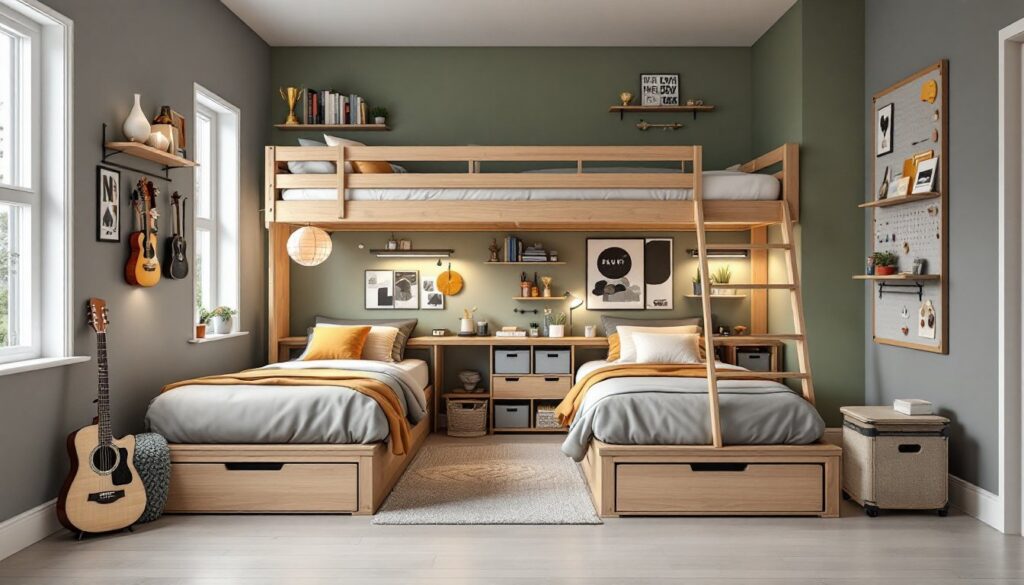
For two boys, consider a staggered configuration: one full loft with a desk underneath, and a second twin bed (either low or lofted) positioned perpendicular or against an adjacent wall. This arrangement preserves floor space and prevents the room from feeling top-heavy. If budget allows, Murphy bed–style lofts or commercial bunk systems (like those from Wayfair or IKEA) offer flexibility, some allow the bottom bed to swing out or fold up on weekends.
Measure ceiling height before buying. Most lofts need at least 7.5 feet of headroom to be comfortable and safe: drywall and ceiling fan clearance further reduce usable height. If you’re tight on space, a low loft (3–4 feet high) still clears floor area while feeling less cave-like. You’ll want ¾” plywood for the platform and 2×6 or 2×8 lumber for the frame, dimensional lumber is critical for load-bearing safety.
Twin Bed Arrangements
If lofting isn’t feasible, perhaps the room is short or you prefer simpler setup, twin beds arranged strategically still work. The most common pattern is perpendicular positioning: one bed along the long wall, the second along the short wall, creating an L-shape that leaves floor space in the center or corner for play and traffic flow.
Alternatively, stack beds end-to-end along the longest wall. This “railroad” approach maximizes floor space and works well in narrow bedrooms. Use a room divider curtain rod or a fabric tension rod hung from wall to wall to give each boy a private alcove within the shared space. Tension rods avoid drilling and holes, just wedge them between walls.
Whichever layout you choose, leave at least 3 feet of clearance in front of the bedroom door and along a main traffic path. Cramped passages make the room feel smaller and create safety hazards. If the room is under 80 square feet, prioritize vertical storage and resist adding too much furniture.
Storage Solutions That Keep Clutter At Bay
Two kids means twice the toys, books, sports gear, and clothes. Without smart storage, a shared bedroom becomes a disaster zone by week two. Vertical storage, shelving, wall-mounted cubbies, and over-door organizers, is your best friend in tight quarters.
Wall-mounted shelving above desks, around windows, or along blank walls holds books, model kits, and trophy, visual clutter that’d otherwise pile on the floor. Use 24″-deep shelves for lighter items and 16″-deep shelves for books and heavier gear. Install shelves at least 12 inches apart vertically so items don’t feel stacked. Anchor shelves into wall studs (typically 16 inches on center) with ¼” lag bolts or heavy-duty toggle anchors if studs aren’t conveniently placed.
Under-bed storage drawers are invaluable for seasonal clothes, bedding, or less-frequently-used toys. Measure the clearance under each bed carefully, a standard bed frame sits about 10 inches off the ground, so an 8″-or 9″-high rolling drawer slides underneath. Label drawers clearly so both kids know where things belong.
Closet systems, not fancy, just organized, prevent chaos. Add a second rod halfway down the existing rod to double hanging space for smaller jackets and shirts. Install a shelf above the main rod for lighter boxes or bins. A hanging shoe organizer on the inside of the closet door or on a wall takes nearly no footprint but stores socks, underwear, and small toys.
Open cubbies or modular bins (IKEA Kallax or similar) work well for frequently accessed items like school supplies, art materials, or gaming controllers. Assign each boy one or two cubbies so ownership is clear. Bins with labels encourage return-to-sender discipline.
Resources like Apartment Therapy and Young House Love offer practical small-space storage tactics that translate well to kids’ rooms, the key is assigning everything a home and sticking to it. When storage is abundant and accessible, kids are far more likely to put things away.
Color Schemes and Design Themes Boys Actually Love
Paint color and décor set the mood and personality of a shared room. Avoid default “boy” stereotypes (navy wall, sports poster, done). Instead, listen to what the boys actually care about and build from there.
Modern Minimalist Palettes
A neutral base, **soft white, warm gray, or pale blue, ** works as a calm backdrop that lets each boy’s interests shine without visual chaos. Pair it with one accent wall in a slightly deeper tone (charcoal gray, sage green, or muted teal) to add dimension without overwhelming the space. Accent walls are also forgiving: if you repaint in five years, you’re touching up one wall instead of four.
When painting, prep is everything. Patch any drywall holes with spackling compound, sand smooth, and prime bare drywall with a primer-sealer before applying finish paint. A gallon of paint covers roughly 350–400 square feet depending on the wall texture and paint quality. Two coats ensure even color, especially over existing finishes.
Choose durable, wipeable finishes, semi-gloss or satin is smarter than flat for kids’ rooms. Flat paint shows every fingerprint and scuff: glossier finishes resist stains and are easier to clean. Brands like Sherwin-Williams Emerald or Benjamin Moore Advance offer washability and durability that justify the upfront cost.
Adventure and Hobby-Based Themes
Two boys with different interests can share a bedroom if the design accommodates both. Rather than forcing a single “space ship” or “dinosaur” theme, create a flexible canvas where both hobbies coexist. For example: one wall is a climbing hold pegboard (great for an active kid): another features floating shelves for a guitar collection or model airplanes.
Use removable wallpaper, vinyl decals, or stencils for hobby touches so you’re not committing to permanent paint. Peel-and-stick maps, constellation murals, or sports-themed graphics stick easily and come off without damage when interests shift (and they will).
Personal bedroom zones reinforce individuality even in a shared space. Assign each boy one corner, wall section, or cubby to decorate but he likes, photos, posters, awards, whatever. This autonomy prevents resentment and lets each kid feel ownership. Addicted 2 Decorating demonstrates how budget-friendly paint projects and decor hacks can transform a room’s personality without overhaul costs.
Lighting plays a huge role in ambiance. A central ceiling fixture provides work light, but add task lighting over desks (adjustable clip lamps or desk lamps) and soft wall sconces or LED strip lights around shelves for a less institutional feel. Dimmable bulbs let the boys adjust mood, bright for assignments, softer for wind-down. Avoid harsh, flickering fluorescent overhead lights: they exhaust young eyes and kill any room’s vibe. Keep cords organized with adhesive cable clips and tuck excess length behind furniture to prevent trip hazards and visual mess.