Table of Contents
ToggleA deck’s overhang is often overlooked, yet it’s one of the most practical spaces on your outdoor structure. Extending shade and shelter beyond your deck’s edge protects furniture, prolongs stain and finish life, and creates a comfortable zone for bad weather days. Whether you’re building new or retrofitting an existing deck, deck overhang ideas range from simple fixed structures to high-tech retractable systems. This guide walks through modern approaches, from pergolas and awnings to green roofs and budget-friendly DIY solutions, so you can choose what fits your climate, space, and skill level.
Key Takeaways
- Deck overhang ideas range from pergolas and retractable awnings to green roofs, each offering different benefits for weather protection and furniture longevity based on your climate and budget.
- Proper structural support is critical: all overhangs require concrete footings at least 3 feet deep and ledger board attachment using ½-inch lag bolts spaced 16 inches apart to prevent failures.
- Retractable awning systems ($1,500–$4,000) offer flexibility with motorized or manual options, while fixed pergolas ($3,000–$8,000+ for louvered models) provide durable, low-maintenance shade with adjustable slat designs.
- Lighting solutions like recessed LED fixtures (requiring 800–1200 lumens for a 12×12-foot area) and IP65-rated wet-location fixtures make overhangs usable after sunset while warm white LEDs (2700K–3000K) reduce insect attraction.
- Living overhangs with climbing vines and green roofs add beauty and insulation but demand ongoing irrigation, pruning, and structural engineering to handle 10–20 pounds per square foot when saturated.
- Choose durable materials like solution-dyed acrylic fabric (10+ years lifespan), composite trim, stainless steel hardware in coastal areas, and proper flashing to prevent water damage and extend your overhang’s life.
Modern Pergola And Shade Structures
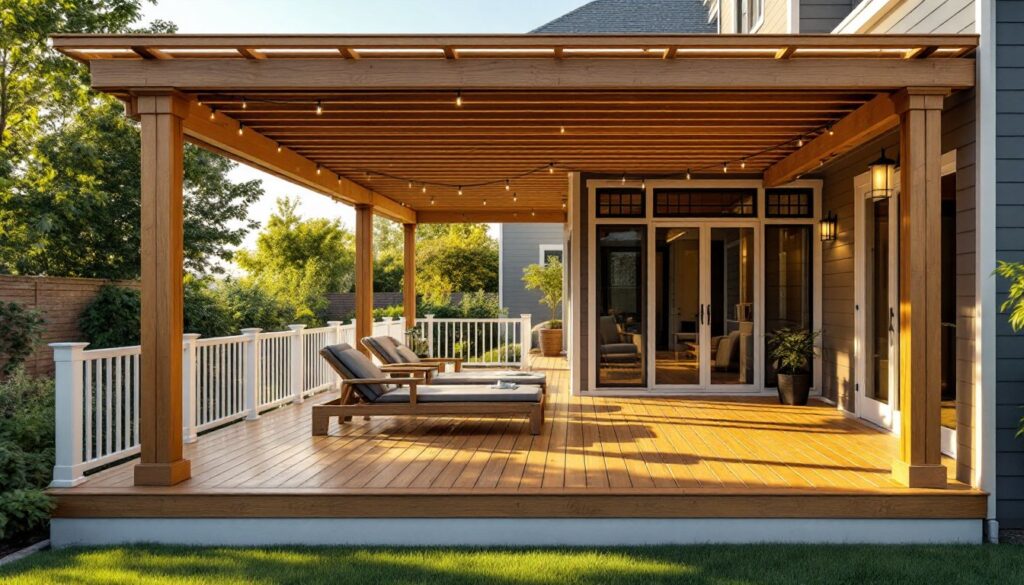
Pergolas remain a top choice because they balance aesthetics with function. A fixed pergola overhang extends 4–8 feet from the deck edge, supported by posts and beams tied into the ledger board or joist system. The open lattice or slat design filters sunlight without complete blockage, creating dappled shade that’s less oppressive than a solid roof.
For structural soundness, the beam supporting your overhang must sit on a proper foundation, concrete footings, not soil. Load-bearing capacity matters: a 6-foot overhang with snow load, wind, and its own weight can easily demand 4×12 or larger lumber depending on span and post spacing. If your deck is already built, a freestanding pergola avoids tying into an existing structure, though it requires its own dedicated footing system.
Louvered pergolas are the premium alternative, with adjustable slats that rotate to control shade and ventilation. These cost more upfront (typically $3,000–$8,000+ installed for a 12×12-foot structure) but offer summer cooling and winter sun exposure. They’re motorized in many cases, requiring an electrician and occasional maintenance. Consider your local wind speeds and snow load before committing: some jurisdictions require engineer-stamped designs for structures over a certain size.
Retractable Awning Systems
Retractable awnings give you flexibility without permanent installation. A manual crank or motorized system rolls fabric in and out, letting you adapt shade to the sun’s angle and season. They mount directly to the deck’s ledger board or an overhead beam, and a typical 12-foot span runs $1,500–$4,000 depending on motor type and fabric quality.
Fabric choice affects durability and maintenance. Solution-dyed acrylic withstands UV and mildew better than vinyl, and it won’t stick to itself in humidity. Check the awning’s angle when deployed, it should pitch slightly forward so rain drains away rather than pooling in the fabric.
One real advantage: if a storm hits, you can roll it up instantly. That’s critical if you live in high-wind regions or experience frequent sudden downpours. But, motorized systems require electrical work and occasional repairs. Manual cranks are lower-tech but demand more effort in a pinch. Make sure mounting hardware is rated for your local wind speeds: most building codes require calculations or engineer approval for permanent shade structures.
Lighting Solutions For Extended Overhangs
An overhang without lighting becomes unusable after sunset. Recessed LED fixtures in a soffit or pergola beams create ambient light without harsh shadows. String lights or cable-run systems offer a more casual aesthetic while keeping wiring hidden. For new construction, run electrical during framing: retrofitting requires raceways or conduit.
Consider lumens per watt, not just bulb count. Warm white LEDs (2700K–3000K color temperature) feel inviting and reduce insect attraction compared to cool white or daylight LEDs. A 12×12-foot overhang area typically needs 800–1200 lumens total, split among fixtures to avoid glare.
In wet locations, use fixtures rated IP65 or higher, that means sealed against jets of water. Check your local electrical code (usually NEC Article 680–690) for wet-location requirements. If you’re adding electrical to an existing structure, hire a licensed electrician: improper installation voids insurance and creates fire hazards. Solar-powered accent lights on railings are a lower-risk option for ambient effects.
Green Roof And Living Wall Overhangs
Living overhangs, with climbing vines, green roofs, or wall-mounted planters, add insulation, reduce runoff, and improve aesthetics. Clematis, climbing hydrangea, and fast-growing ivies can shade an overhang within one growing season if you plant on a cable or trellis system.
A shallow green roof (2–4 inches of growing medium) is lighter than you’d think, roughly 10–20 pounds per square foot when saturated, but it still requires structural support and waterproofing. The deck’s framing must be designed for it: a typical pergola beam isn’t enough. This is structural work: hire an engineer to calculate live load, dead load, and drainage.
Cables or wire meshes support heavy vines without adding much load. Install them before planting, anchored firmly to the overhang frame. Keep vines trimmed away from gutters and fascia to avoid moisture damage. Living systems also demand irrigation in dry months and occasional pruning. If you’re in a cold climate, choose hardy varieties that survive winter dormancy: tender tropicals won’t come back after the first frost. This approach is beautiful but maintenance-intensive: factor that into your decision.
Durable Material Choices For Year-Round Protection
Your overhang material choice determines how long it lasts and how much maintenance you’ll do. Pressure-treated lumber is standard and affordable, but it needs resealing every 2–3 years. Composite materials like Trex or PVC trim resist rot and splitting, though they’re pricier upfront ($2–$4 per linear foot vs. $0.80–$1.50 for pressure-treated).
For shade fabric, Sunbrella or equivalent solution-dyed acrylics last 10+ years with occasional cleaning. Vinyl awning fabric is cheaper but degrades faster in UV light. Metal roofs (standing seam or corrugated) shed snow and rain efficiently but require flashing details to prevent leaks where they meet the deck.
In coastal areas, use stainless steel hardware and galvanized bolts to resist salt corrosion. Ordinary steel fasteners rust quickly near ocean spray. Snow-load regions demand heavier framing: check your local building code or ask the building department for design loads (typically 20–50 psf depending on elevation and climate).
Undecorative but essential: proper flashing where the overhang meets your house prevents water from entering the wall cavity. Use ice-and-water shield under the ledger if you’re in a freeze-thaw climate. Most deck failures trace back to poor flashing or water management, not frame design.
Budget-Friendly DIY Overhang Projects
Not every overhang needs motorized systems or professional installation. A simple fixed pergola is achievable with basic carpentry skills, hand tools, and a post-hole digger. You’ll need pressure-treated 4×4 posts, 2×10 or 2×12 beams, and 2×4 or 2×6 joists for the top slats.
Start by setting concrete footings at least 3 feet deep (below frost line in cold climates) for each post. Mix and pour 60-pound concrete bags into a frost-proof footing hole: a post-level device ensures vertical alignment. Once concrete cures (24–48 hours), bolt the posts using ½-inch bolts with washers and lock nuts, no flimsy nails. Ledger board attachment is critical: use ½-inch lag bolts or structural screws spaced 16 inches apart, drilled into the rim joist or band board, never into siding alone.
Building authorities often approve small pergolas under local square-footage thresholds without a permit, but check your zoning rules first. Even if not required, a permit gives you an inspection, a free safety check. Most DIY overhang failures happen when someone skips footings or attaches ledgers to vinyl siding instead of the house structure itself.
A simple fabric shade stretched on cables costs under $300. Run stainless steel cable between posts, rig turnbuckles for tension, and attach outdoor fabric with carabiners so you can adjust or remove it seasonally. Not permanent, but fast and reversible. Pair it with expert contractor recommendations if you’re unsure about load calculations or local codes.
Conclusion
Deck overhangs solve real problems: weather protection, furniture longevity, and year-round usability. Your choice depends on budget, climate, and willingness to maintain a living system versus a static structure. Fixed pergolas are durable and low-maintenance. Awnings offer flexibility. Green roofs add beauty but demand attention. Whatever you choose, start with solid footings, proper flashing, and an honest look at local building codes. That foundation keeps your overhang standing and your investment protected.