Table of Contents
ToggleA morning cup of coffee tastes better when it’s brewed at home, especially when your setup looks as good as a café. A countertop coffee bar brings convenience, style, and functionality directly to your kitchen. Whether you have a sprawling counter or a tight corner, there’s a coffee bar design that fits your space and lifestyle. In 2026, homeowners are ditching the cluttered appliance graveyard approach and opting for intentional, organized coffee stations that double as décor. This guide walks you through seven practical coffee bar ideas, from minimalist setups to rustic corners to modern espresso stations, complete with real tips on equipment, layout, and lighting.
Key Takeaways
- A countertop coffee bar brings convenience, style, and organization to your kitchen with designs ranging from minimalist setups under $300 to modern espresso stations costing $1,200–$2,500.
- Successful coffee bar designs prioritize intentional layout and essential equipment—a quality burr grinder, single brewing method, and smart storage—over cluttering your counter with unnecessary appliances.
- Lighting transforms your coffee bar from functional to inviting: use pendant lights 24–30 inches above the counter or removable LED strips to create both task and ambient illumination.
- Small spaces accommodate coffee bars through vertical solutions like bar carts, single floating shelves, or over-the-sink units that keep your setup self-contained without sacrificing style.
- Rustic and modern coffee bar styles both benefit from airtight bean storage, organized grouping of tools on trays, and a waste bowl to maintain cleanliness during your morning ritual.
Minimalist Coffee Bar Setup
A minimalist coffee bar strips away excess and focuses on essentials: a grinder, brewer, and storage for beans and cups. This approach works beautifully on a small wall shelf or 18- to 24-inch section of counter.
Start with a wall-mounted shelf (typically 12 inches deep) anchored into wall studs for safety, use 2.5-inch screws and heavy-duty brackets rated for at least 25 pounds. Your grinder and brewer sit on the shelf: everything else tucks into a small wooden cabinet or open woven baskets below for beans, filters, and mugs. Keep the color palette neutral: matte black, white, or natural wood tones.
The real trick is choosing one primary brewing method. A Chemex or Aeropress brewer looks intentional and takes minimal counter space, roughly 6 by 8 inches. Pair it with a burr grinder (essential for consistent grind size) and a small stainless steel kettle. That’s your whole setup.
Minimalist bars work because they force you to stay organized. No room for clutter means you actually wash your cup after use instead of stacking three on the shelf. Budget around $150 to $300 for quality essentials, depending on your brewer choice.
Create A Rustic Coffee Corner
Rustic coffee bars lean into wood, warm metals, and a lived-in vibe. Think open shelving with real wood beams, industrial pipe brackets, and vintage-style jars for bean storage.
Start by reclaiming or sourcing 1-inch thick reclaimed or new wood boards (popular widths are 12, 14, or 18 inches). Have them cut to length and stained or finished with a matte polyurethane, this protects against water rings from mugs and the occasional spill. Mount them 36 inches above the counter on black or bronze iron pipe brackets (available from hardware stores: use lag bolts into studs for load-bearing support).
Below the shelves, add a wooden cabinet with door fronts, either real reclaimed pieces or new wood stained to match. Inside, store a larger espresso machine, a milk frother, and brewing gear. Glass jars with wood lids hold whole beans: labels add a farmhouse touch.
Incorporate warm metals: a brass or copper kettle and metal scoops. A small wooden cutting board becomes a serving surface for cups and sweeteners. String café-style lighting overhead (addressed in the next section) to complete the cozy aesthetic.
Budget: $400 to $800, depending on whether you’re using reclaimed wood and the size of the shelving system. Reclaimed wood costs more upfront but adds authentic character that new stained wood can’t quite match.
Modern Espresso Station Design
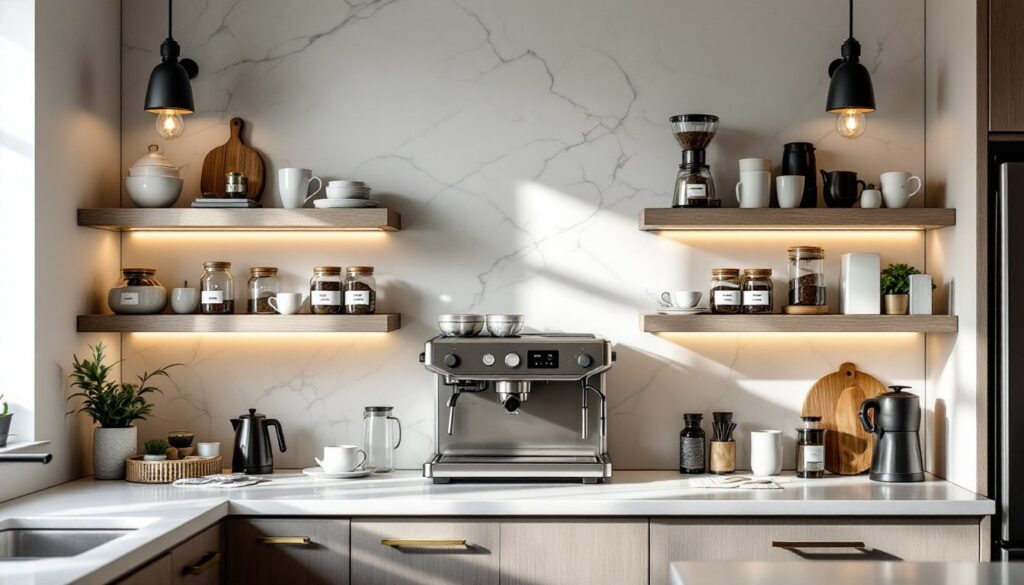
A modern espresso bar centers on a quality espresso machine, the heart of the operation, flanked by sleek storage and accessories. Think clean lines, matte finishes, and integrated appliances.
Measure your counter space carefully. Most compact espresso machines run 13 to 18 inches wide and 12 inches deep. A marble or quartz backsplash (12 inches high, behind the machine) adds visual interest and protects the wall from water splashes. Install it with thin-set mortar and a notched trowel, letting it cure per instructions, typically 24 hours.
On either side of the espresso machine, install floating shelves made of white oak or matte lacquer plywood, 12 to 18 inches wide. One shelf holds a burr grinder and a small cup warmer or milk frother. The other stores espresso cups (typically 3 to 4 ounces each), a portafilter stand, and cleaning supplies. Use pin-style shelf brackets rated for 50+ pounds to support the machine’s weight if you’re floating a shelf directly below it.
Add a small stainless steel or concrete countertop extension (24 by 18 inches, minimum) as a work surface. This is where you tamp grounds, steam milk, and pull shots. Keep it clear of clutter, a good modern espresso bar looks almost surgical.
Budget: $1,200 to $2,500, depending on the espresso machine. A quality home machine (like a Gaggia, Breville, or Rancilio) starts around $600 to $1,000. Shelving, backsplash, and accessories add $400 to $800.
Pro tip: Install a small drain pan under the machine, espresso machines drip, and water damage to cabinets below isn’t worth the hassle. A stainless steel drain pan (6 by 12 inches) costs about $25 to $40.
Compact Coffee Bar For Small Spaces
Small apartments and kitchens don’t need to sacrifice a coffee bar: they just need smart boundaries. Use a single shelf or compact cart to define the space without eating real estate.
A wooden bar cart (roughly 24 by 18 inches and 30 inches tall) is portable and tucks into a corner or slides under an overhang when not in use. Place a burr grinder on the top tier, brewer and kettle on the middle tier, and mugs plus beans on the bottom. This vertical arrangement saves counter space and keeps everything within arm’s reach.
Alternatively, mount a single 18-inch-wide floating shelf on an unused wall patch, even behind a door or in a hallway alcove works. One brewer, one grinder, one small storage basket. Stack mugs vertically to save space.
For renters or those who can’t drill, a narrow over-the-sink shelf unit (24 by 12 inches, 18 inches tall) uses the sink frame as support without wall anchors. It keeps your coffee station visible but self-contained.
The key constraint in small spaces: commit to one brewing method and minimal bean inventory. Don’t try to fit both a Chemex and an Aeropress and a pour-over cone. Pick one, master it, and let it be your identity.
Budget: $50 to $200. A basic wooden cart runs $80 to $120. A floating shelf and brackets cost $30 to $60, plus the cost of installation. This is one of the most affordable options.
Coffee Bar Lighting & Ambiance
Lighting transforms a coffee bar from functional to inviting. Don’t rely on overhead kitchen lights: add task and ambient lighting directly at the bar.
Pendant lights (8 to 10 inches in diameter) hung 24 to 30 inches above the counter create a focal point and illuminate the space without glare. Choose matte black, brass, or frosted glass finishes that complement your bar’s style. For rustic bars, café-style Edison bulb fixtures add warmth: for modern setups, consider sleek pendant lights in matte black or chrome.
If ceiling-mounted lights aren’t an option (renting, structural limits), use under-shelf LED strip lights to illuminate the counter and create ambient glow. Install them with removable adhesive backing so you won’t damage walls. These run $15 to $40 per strip and plug into standard outlets.
A small desk lamp or swing-arm wall sconce beside the bar provides task lighting for grinding beans or reading labels on bags. Warm white bulbs (2700K to 3000K) are more inviting than cool whites for a morning ritual.
Dimmers are your friend. They let you brighten the space for focus work (dialing in grind size, tamping espresso) and dim it for a more café-like ambiance when guests visit.
Budget for lighting: $80 to $300, depending on fixture quality and whether you hire an electrician to hard-wire pendant lights (recommended for safety and cleanliness).
Essential Equipment & Organization Tips
A functional coffee bar hinges on the right tools and smart organization. Here’s the non-negotiable equipment list, plus storage strategies that actually work.
Core Equipment:
- Burr grinder (conical or flat burrs: avoid blade grinders for inconsistent results)
- Brewing device (Chemex, Aeropress, Espresso machine, Moka pot, or French press)
- Gooseneck kettle (narrow spout for pour-over precision, typically 1.2 liters)
- Digital scale (to measure beans accurately: $20 to $40 models work fine)
- Storage jars for whole beans (airtight, opaque, kept away from heat and direct sunlight)
- Mugs and cups (your favorites, plus extras for guests)
- Cleaning supplies (small cloth, brush for grinder, espresso machine backflush kit if applicable)
Organization Wins:
Use a small wooden tray or lazy Susan on your shelf to group items by function: the grinder lives on one corner, small tools (scoop, tamper, milk thermometer) nestle nearby. Beans stay in a cabinet below, separate from brewing devices. This grouping makes your morning routine flow without hunting for tools.
Label everything, especially if you rotate bean origins or roasts. Small label makers are inexpensive and take the guesswork out of “Is this the medium roast or dark roast?”
Keep a small waste bowl on your bar, it catches used grounds and prevents mess. A 2-cup ceramic bowl ($8 to $15) tucked beside the grinder becomes essential.
For espresso setups, store your portafilter and basket upright in a small stand to air-dry. Moisture trapped in the group head causes corrosion. A stainless steel portafilter stand costs $10 to $20.
Rotate your bean inventory. Don’t stockpile beans for months: whole beans peak in flavor for 2 to 3 weeks after roasting. Smaller, frequent coffee shipments keep your bar tasting fresh and prevent stale stock from taking up shelf space.
Budget for equipment and organization: $200 to $500, depending on brewer type and quality grinder. A quality burr grinder (the most important upgrade you can make) runs $80 to $200. Everything else slots in below that.
Conclusion
A countertop coffee bar isn’t just about storing your brewer and beans, it’s a dedicated ritual space in your home. Whether you lean minimalist, rustic, or modern, the foundation stays the same: quality equipment, thoughtful layout, and honest prep work. Start with one of these seven approaches, measure your space carefully, and don’t skip the details like lighting and organization. Your kitchen’s most-used corner will thank you, and your morning coffee will taste even better.